
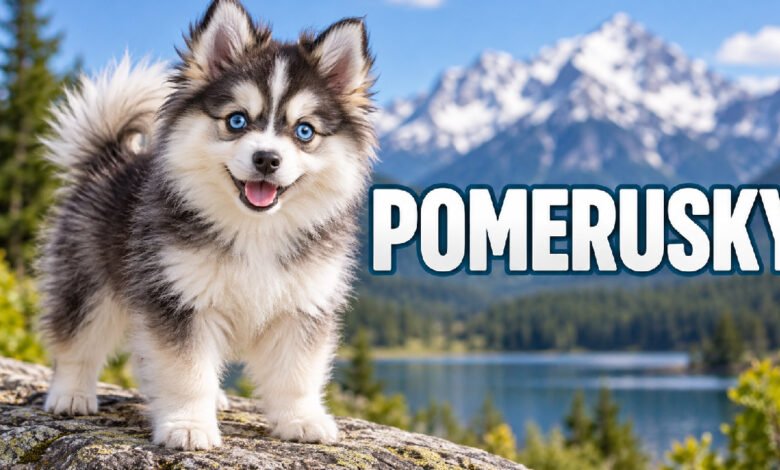
The Pomerusky is a small and fluffy dog created from a Pomeranian and a Siberian Husky. It often attracts attention because it can combine the compact body of a Pomeranian with the striking face, pointed ears, thick coat, and expressive eyes associated with a Husky.
However, appearance is only one part of understanding this dog. A Pomerusky can be energetic, intelligent, playful, vocal, affectionate, and sometimes independent. Its personality and physical features can vary because puppies may inherit different traits from each parent.
Before bringing one home, owners should understand its exercise, grooming, feeding, training, health, and companionship needs. This detailed Pomerusky guide explains its background, size, appearance, temperament, daily care, possible health concerns, costs, and suitability for different households.
What Is a Pomerusky?
A Pomerusky is a cross between a Pomeranian and a Siberian Husky. It is more commonly called a Pomsky, while Pomerusky is another name used for the same general mix. Because two different parent breeds are involved, the Pomerusky is considered a hybrid or designer dog rather than a standardized purebred breed.
The combination is interesting because its parents are very different. Pomeranians are small companion dogs with fluffy coats, while Siberian Huskies are larger working dogs known for endurance, activity, and distinctive physical features. Their offspring can inherit characteristics from either side.
This genetic variety means there is no single appearance, size, or personality that describes every Pomerusky. One may closely resemble a miniature Husky, while another may show stronger Pomeranian features. Future owners should therefore prepare for individual variation rather than expecting an exact result.
Pomerusky Origin and History
The Pomerusky is relatively new compared with established dog breeds that have documented histories extending across many generations. Interest in this cross developed alongside the popularity of designer dogs, especially among people who liked the appearance of Siberian Huskies but were interested in a smaller companion.
The two parent breeds have very different backgrounds. The Siberian Husky developed as a working sled dog and is associated with endurance and physical activity. The Pomeranian developed into a much smaller companion breed and became known for its compact body, thick coat, alert personality, and close relationship with people.
Combining these breeds created a dog with considerable genetic variation. Social media later increased interest because photographs and videos highlighted fluffy coats, Husky-like markings, unusual eyes, and expressive behavior. Despite this popularity, owners should remember that appearance alone does not determine whether this cross fits their lifestyle.
How Pomeruskies Are Bred
Breeding Pomeranians and Siberian Huskies requires careful planning because there is a considerable difference in their normal body sizes. Responsible breeding should place the health of the parent dogs and puppies ahead of producing a particular coat color, eye color, facial appearance, or unusually small adult size.
Artificial insemination may be used because of the size difference between the parent breeds. The larger Siberian Husky is commonly associated with the maternal side in first-generation breeding. However, breeding arrangements can differ, particularly when later generations of Pomeruskies are involved.
Owners may also encounter terms such as F1 when researching puppies. An F1 Pomerusky results directly from Pomeranian and Siberian Husky parents, while later generations can involve Pomeruskies in subsequent breeding. Generation may influence certain characteristics, but it cannot guarantee exact size, temperament, coat type, markings, or eye color.
Pomerusky Size, Height, and Weight
Pomerusky size is one of the characteristics that prospective owners should understand carefully. Because Pomeranians and Siberian Huskies differ greatly in body size, their offspring do not have the tightly controlled adult measurements associated with a standardized breed. Genetics and parent size can strongly influence development.
Reported estimates commonly place these dogs at approximately 10 to 15 inches in height. Weight estimates can vary more widely, with some descriptions placing adults from around 7 to 25 pounds and others giving somewhat broader ranges. These figures should be treated as general estimates rather than guarantees.
A small puppy will also not necessarily remain extremely small as an adult. Anyone for whom adult size is particularly important should examine the parents and ask about previous litters. Marketing descriptions such as “tiny” or “mini” should never replace realistic information about genetics and expected development.
Pomerusky Appearance, Coat, and Eye Colors
The Pomerusky is famous for its attractive appearance, but individual dogs can look surprisingly different. Some develop pointed ears, defined facial markings, and a Husky-like expression. Others inherit a rounder face, smaller frame, or other characteristics that make their Pomeranian ancestry much easier to recognize.
Many Pomeruskies have thick, fluffy coats influenced by their double-coated parents. Possible colors include white, gray, black, cream, brown, red, and combinations of different shades. Husky-style facial patterns may occur, although particular markings should never be expected in every puppy.
Eye color can create even more variation. Brown and blue eyes are possible, while some dogs may have differently colored eyes. Despite the popularity of bright blue eyes in photographs, they are not guaranteed. Adult coat texture, markings, size, and eye appearance ultimately depend on the traits an individual dog inherits.
Pomerusky Temperament and Personality
A Pomerusky can be affectionate, curious, playful, intelligent, and highly involved with its household. Many enjoy spending time with people, exploring their surroundings, playing games, and participating in everyday activities. These characteristics can make the dog an entertaining companion for owners who enjoy regular interaction with their pets.
Intelligence does not always make ownership effortless. The Husky side can contribute independence, while Pomeranians can be alert and expressive. A Pomerusky may therefore learn what an owner wants quickly but sometimes become distracted or prefer doing something more interesting. Consistent household rules are especially useful.
Vocal behavior is another consideration. Some Pomeruskies may bark frequently or make expressive sounds associated with Huskies. Individual temperament varies, so not every dog behaves identically. Genetics, socialization, environment, experiences, training, exercise, and the owner’s daily routine can all influence adult behavior.
Pomerusky Training and Socialization
Training should begin early because intelligent and energetic puppies can quickly develop both desirable and undesirable habits. Basic lessons can include responding to a name, sitting, waiting, walking properly on a leash, coming when called, and leaving inappropriate objects alone. Clear and consistent rules make everyday life easier.
Positive reinforcement can work well with a Pomerusky. Treats, praise, toys, and other appropriate rewards help the dog associate cooperation with a positive result. Short and interesting sessions are usually more practical than repeating the same lesson until an energetic dog becomes bored or loses concentration.
Socialization is equally important. Puppies benefit from controlled experiences involving different people, environments, sounds, surfaces, handling, and suitable dogs. Early positive experiences can help build confidence as the puppy develops. Owners should also address jumping, unnecessary barking, leash pulling, and other unwanted habits before these behaviors become established routines.
Pomerusky Exercise and Mental Stimulation
A Pomerusky may have a relatively compact body, but owners should not assume that a smaller dog automatically needs little exercise. Siberian Husky ancestry can contribute considerable energy, curiosity, and interest in activity. Regular physical exercise is therefore an important part of maintaining healthy everyday behavior.
Daily activity can include walks, supervised play, training exercises, interactive games, and opportunities to explore safely. Mental stimulation matters as well. Puzzle toys, scent games, learning new behaviors, and other problem-solving activities can provide useful outlets for an intelligent dog that might otherwise create its own entertainment.
Exercise needs vary according to age, health, size, and individual energy. Puppies require age-appropriate activity rather than demanding endurance exercise. Healthy adults may tolerate considerably more. When physical and mental needs are repeatedly overlooked, behaviors such as chewing, digging, restlessness, barking, escaping, or excessive attention-seeking can become more noticeable.
Pomerusky Grooming and Shedding
Grooming is one of the most important routine responsibilities associated with Pomerusky ownership. Both parent breeds can have substantial coats, so many Pomeruskies develop dense fur that sheds regularly. Seasonal shedding can be particularly noticeable and may require more frequent brushing than during quieter periods of the year.
Regular brushing removes loose hair and helps prevent knots and matting. Depending on the individual coat, brushing several times each week may be appropriate, while heavier shedding can require daily attention. Grooming also provides an opportunity to notice skin irritation, parasites, unusual lumps, or changes hidden beneath thick fur.
Bathing should be based on cleanliness and individual grooming requirements rather than an unnecessarily frequent schedule. Owners also need to monitor nails, ears, and teeth. Professional grooming can be useful, especially for coat maintenance and nail care, but it does not replace the regular brushing and basic grooming that should happen at home.
Pomerusky Food and Feeding Needs
There is no single amount of food that is suitable for every Pomerusky. Appropriate portions depend on the dog’s age, adult size, body condition, health, activity level, and the calorie content of its food. A growing puppy also has nutritional requirements that differ from those of a healthy adult dog.
Owners should choose nutritionally appropriate food for the dog’s life stage and follow feeding guidance while monitoring body condition. Puppies may require meals divided throughout the day, while adults can follow a consistent feeding routine suited to their individual needs. Treats should also count toward the dog’s overall daily calorie intake.
Clean drinking water should remain available, and sudden unnecessary diet changes are best avoided. If a dog develops digestive discomfort, skin changes, unusual weight gain, weight loss, or another feeding concern, veterinary advice is appropriate. Feeding should focus on healthy development and condition rather than copying another owner’s exact portion.
Pomerusky Health Problems and Lifespan
Because the Pomerusky is a relatively young cross, it does not have the same long history of breed-specific health information available for many established breeds. Potential concerns can come from either parental line, which makes responsible breeding, parental screening, and regular veterinary care particularly important.
Possible concerns associated with the parent backgrounds can include hip problems, luxating patella, eye conditions, dental problems, skin or allergy issues, and collapsing trachea. These are potential health risks rather than conditions that every Pomerusky will develop. Buyers should ask breeders for documentation of relevant health screening instead of relying only on verbal promises.
A lifespan of approximately 12 to 15 years is commonly associated with the cross, although individual longevity varies. Balanced nutrition, suitable exercise, dental care, healthy body condition, preventive veterinary treatment, vaccinations, parasite control, and early attention to unusual physical or behavioral changes can support long-term health.
Are Pomeruskies Good Family Dogs?
A well-socialized Pomerusky can become an affectionate and enjoyable family companion when its personality matches the household. These dogs can enjoy attention, play, training, and involvement in everyday family activities. However, suitability should be judged by the individual dog’s temperament rather than assuming every Pomerusky behaves the same way.
Families with children should teach respectful interaction from the beginning. Children should not pull fur, climb on the dog, disturb it while eating or sleeping, or chase it when it wants space. Adults should supervise younger children and ensure that both the child and dog understand appropriate boundaries.
Living with other pets can also be successful, but introductions and individual behavior matter. Early socialization may help, while prey drive and excitement should be considered around smaller animals. A calm introduction, sensible supervision, training, and management provide a stronger foundation than relying only on breed-mix expectations.
Can a Pomerusky Live in an Apartment?
A Pomerusky can live in an apartment when the owner consistently meets its physical, mental, and social needs. The amount of indoor floor space is not the only consideration. A dog living in a smaller home can still be content when it receives appropriate outdoor activity, enrichment, companionship, and training.
Vocal behavior can be a bigger concern than size. A Pomerusky that frequently barks, howls, or makes other expressive sounds can create difficulties with nearby neighbors. Owners should encourage calm behavior early and avoid accidentally rewarding barking whenever the dog wants attention, food, play, or access to something.
Regular walks remain important even when a dog has comfortable indoor space. Apartment owners also need practical plans for toilet breaks, training, play, and mental stimulation. A large house is not automatically better if the dog receives insufficient interaction, while a responsible apartment routine can work successfully for a suitable individual.
Pomerusky Price and Long-Term Ownership Costs
The purchase price of a Pomerusky can vary considerably according to breeder, location, parent dogs, demand, and other factors. Prices around $1,000 to $3,500 are frequently mentioned, but buyers should not assume that a higher price automatically means healthier breeding or better temperament. Appearance should not determine quality either.
The initial purchase is only one part of the financial commitment. Owners should budget for suitable food, routine veterinary visits, vaccinations, parasite prevention, grooming, dental care, training, toys, bedding, collars or harnesses, identification, and other everyday supplies. Unexpected veterinary treatment can create additional costs during the dog’s lifetime.
A prospective owner should therefore consider long-term affordability rather than asking only how much a puppy costs. Pomeruskies may live for many years, making ownership a substantial commitment of both money and time. Preparing for routine and unexpected expenses helps owners provide consistent care throughout the dog’s life.
Choosing a Healthy Pomerusky Puppy
Choosing a Pomerusky should involve much more than selecting the puppy with the brightest eyes or most dramatic Husky markings. Prospective owners should learn about the parents’ health, size, and temperament because these characteristics provide useful information about what puppies could potentially inherit as they mature.
A responsible breeder should be prepared to discuss parental health screening, veterinary history, puppy care, early socialization, and the conditions in which puppies are raised. Healthy surroundings and appropriate interaction are more meaningful than attractive advertisements. Buyers should request relevant health documentation rather than relying entirely on promises made during a sale.
Extreme claims deserve caution. No responsible seller can guarantee exactly how every mixed-breed puppy will look or behave as an adult. Promises involving extremely small size, particular eyes, exact temperament, or other special characteristics should not become the main reason for choosing a dog. Health and suitability should come first.
Pomerusky vs Pomeranian vs Siberian Husky
The Pomeranian, Siberian Husky, and Pomerusky should not be viewed as three versions of exactly the same dog. A Pomeranian is a small companion breed, while the Siberian Husky is a considerably larger working breed developed for endurance. Their exercise requirements, physical proportions, and behavioral tendencies can therefore differ greatly.
A Pomerusky falls between these parental backgrounds but does not necessarily represent a perfect halfway point. It may remain considerably smaller than a Husky while inheriting substantial energy, intelligence, independence, vocal behavior, or a dense coat. Another individual may display stronger Pomeranian characteristics in both appearance and behavior.
This unpredictability is important when selecting a dog. Someone wanting a reliably small companion may prefer the predictability of an established small breed. Similarly, someone specifically wanting traditional Husky characteristics should not assume a Pomerusky provides exactly the same experience in a smaller body. The cross should be appreciated for its own variation.
Pomerusky vs Pomsky: Are They the Same?
Pomerusky and Pomsky are generally names used for the same basic Pomeranian and Siberian Husky combination. Pomsky is the more widely recognized shortened name, while Pomerusky provides a more direct combination of the parent breed names. The use of different terms can sometimes make new owners think they describe separate dogs.
The name does not create a different breed standard. A dog advertised as a Pomerusky can still inherit the same broad range of characteristics expected from a Pomeranian and Siberian Husky cross. Buyers should focus on parentage, health, temperament, generation, and responsible breeding instead of placing too much importance on the marketing name.
Understanding this naming issue is useful when researching ownership. Information listed under Pomsky may therefore be relevant to someone searching for Pomerusky information. Regardless of terminology, individual variation remains one of the most important characteristics of this cross.
Is a Pomerusky the Right Dog for You?
The Pomerusky can suit people who want an intelligent, affectionate, active, and highly interactive companion. Owners who enjoy walking, playing, training, grooming, and spending regular time with their dog may appreciate its combination of lively behavior and close family involvement. Its smaller size can also suit different home environments.
However, it should not be chosen only because it looks like a tiny Siberian Husky. Shedding can be substantial, grooming requires time, vocal behavior may become challenging, and exercise needs can be greater than its appearance suggests. Training also requires patience when an individual dog develops an independent or stubborn personality.
The best match is an owner prepared for variation. A Pomerusky may not reach an expected size, develop blue eyes, or behave exactly like either parent. People comfortable with those differences and prepared for long-term training, exercise, grooming, veterinary care, and companionship are better positioned for successful ownership.
Final Thoughts
The Pomerusky combines two very different canine backgrounds, which is exactly what makes this dog both appealing and less predictable. Its fluffy coat, expressive face, playful behavior, intelligence, and possible Husky-like appearance attract attention, but responsible ownership requires looking beyond those visible characteristics.
Daily life can involve regular exercise, mental stimulation, consistent training, frequent grooming, appropriate feeding, socialization, and preventive veterinary care. Owners also need to be prepared for shedding, possible vocal behavior, individual health risks, and differences in adult size or personality that cannot be predicted perfectly from puppy photographs.
For the right household, a Pomerusky can become an engaging and affectionate companion for many years. The most important decision is not whether the puppy looks impressive. It is whether the owner’s lifestyle, available time, budget, and expectations can support the dog’s real needs throughout its life.
(FAQs)
What is a Pomerusky?
A Pomerusky is a cross between a Pomeranian and a Siberian Husky. It is also commonly called a Pomsky. These dogs can inherit a fluffy coat, playful personality, intelligence, energy, and physical features from either parent.
How big does a Pomerusky get?
Pomerusky size can vary because the parent breeds are very different in size. Reported estimates often place adults around 10 to 15 inches tall, while weight can vary considerably depending on genetics, parent size, and development.
Does a Pomerusky shed a lot?
Many Pomeruskies can shed heavily because both parent breeds have substantial coats. Regular brushing helps remove loose hair and reduce matting. More frequent or even daily brushing may be needed when a dog experiences heavier seasonal shedding.
Is a Pomerusky a good family dog?
A properly trained and socialized Pomerusky can be an affectionate family companion. Individual temperament still matters. Families should provide regular exercise, training, grooming, mental stimulation, and supervision when younger children interact with the dog.
How long does a Pomerusky live?
A Pomerusky is commonly described as having a lifespan of approximately 12 to 15 years. Individual lifespan can vary depending on genetics, nutrition, exercise, body condition, preventive veterinary care, environment, and overall health.

