
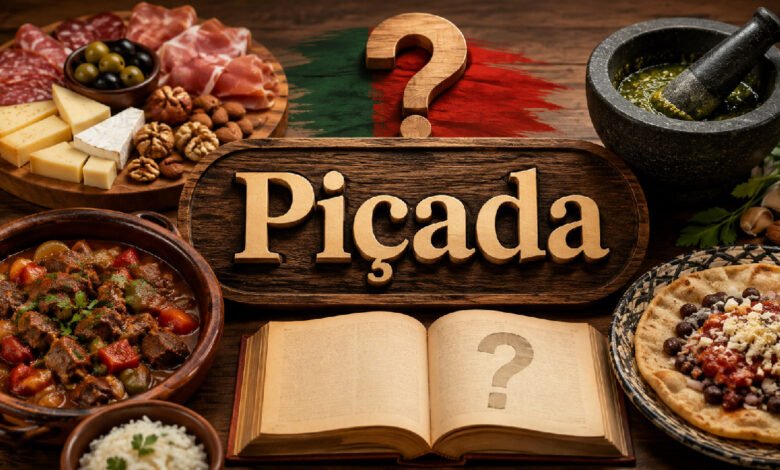
Piçada is a Portuguese word that can be confusing because it looks almost identical to several other words found in Portuguese and Spanish. When people search for it online, they may find explanations about food, trails, meat dishes, footprints, restaurants, or traditional recipes. Many of those results actually belong to different words, especially picada and pisada.
Established Portuguese dictionaries give Piçada a much clearer meaning. Priberam records it as slang and a taboo term meaning a reprimand, while Infopédia describes it as a harsh rebuke, telling-off, or scolding. Both dictionaries also record a vulgar literal meaning connected with male anatomy.
This means Piçada should not automatically be treated as the name of a traditional dish. The exact spelling matters. Removing the cedilla and writing picada creates another word with several completely different meanings.
What Does Piçada Mean in English?
The easiest English meaning of Piçada is a strong scolding, harsh reprimand, or severe telling-off. It describes a situation in which someone is sharply criticized or corrected because of something they have done. It is stronger and rougher than ordinary advice or a gentle warning.
For example, if someone makes a serious mistake and receives a forceful verbal reprimand afterward, the figurative Portuguese term Piçada may fit that type of situation. Priberam specifically labels the word as slang and taboo vocabulary, while Infopédia gives related meanings such as harsh criticism and a telling-off.
The word should therefore be understood through both meaning and tone. It is not simply another neutral Portuguese word for criticism. Its slang background gives it a rough quality. Portuguese learners should be especially careful before using it in conversation, because knowing its English translation does not mean it is suitable in every social situation.
Is Piçada Slang or a Formal Portuguese Word?
Piçada belongs to informal language rather than formal Portuguese. Dictionary classifications are important here because they help readers understand not only what a word means but also where it is socially appropriate. Priberam identifies it as calão and tabuísmo, which indicate slang and taboo usage. Infopédia similarly classifies it as slang and vulgar vocabulary.
Because of this register, Piçada would normally be a poor choice for academic writing, formal business communication, professional emails, official documents, or polite conversations. A neutral Portuguese word for reprimand or criticism would generally be safer in those situations.
Its informal character does not mean the word is incorrect. Slang words can be genuine parts of a language while still being unsuitable for formal settings. The important point is knowing the difference. Readers who encounter Piçada in informal speech, online discussions, jokes, or slang-heavy writing should recognize that its tone may be much stronger than a simple dictionary translation first suggests.
Where Does the Word Piçada Come From?
The origin of Piçada helps explain why the word has such a rough tone. Infopédia gives its formation as the vulgar Portuguese root piça combined with the suffix -ada. Priberam gives a closely related formation using piço + -ada. Both sources therefore connect the word with vulgar vocabulary.
The Portuguese suffix -ada occurs in many nouns and can be involved in words describing an action, result, blow, quantity, or something associated with the base word. The meaning depends on the particular root and the history of the expression.
In the case of Piçada, its literal background eventually also supports a figurative sense connected with being strongly reprimanded. This type of development is common in language, where expressions can move beyond a literal meaning and gain figurative uses. However, the original vulgar association remains important because it affects how the word sounds. That is why speakers should not assume that Piçada is socially neutral.
Is Piçada Offensive or Vulgar?
Piçada can be considered vulgar, especially because dictionaries record a literal meaning involving male genitalia. Priberam lists a taboo literal sense alongside the figurative meaning of reprimand, while Infopédia similarly identifies a vulgar physical meaning.
That does not mean every appearance of Piçada has the same level of offensiveness. Context matters. Someone might use the figurative sense simply to describe a severe telling-off. In another conversation, the literal meaning could make the term considerably more offensive. Tone, audience, location, and the relationship between speakers all influence how slang is received.
For learners of Portuguese, the safest approach is to understand the word without assuming it should be used casually. Standard vocabulary for criticism, reprimand, or correction is usually better in polite communication. Piçada is useful to recognize when reading or listening to informal Portuguese, but it should be handled carefully because its slang history can make it sound rude or crude.
Piçada vs Picada: What Is the Difference?
The difference between Piçada and Picada begins with one small spelling change. Piçada contains the letter ç, while picada contains a regular c. Despite looking nearly identical, the dictionary meanings are different, so the two words should not be treated as alternative spellings of the same expression.
Portuguese dictionaries define picada in several ways. It can refer to the act of pricking, a wound made by a pointed object, an insect bite or sting, a sharp pain, or a narrow path through vegetation. Priberam and Infopédia both record these meanings.
Piçada, by contrast, is associated with slang reprimand and vulgar usage. The confusion becomes greater because Spanish and regional cuisines also use picada for different foods. As a result, a search for Piçada can easily return information that actually describes Picada. Checking whether the word contains ç is therefore the simplest first step.
Does Piçada Mean a Trail or Footprint?
A trail is not one of the main dictionary meanings of Piçada. The narrow-path meaning belongs to picada. Priberam defines picada as, among other things, a shortcut opened with a cutting instrument and a narrow path through vegetation. Infopédia also records a narrow path through brush or woodland.
The footprint explanation comes from another similar word: pisada. Because Piçada, picada, and pisada look and sound relatively close, web pages and search queries can sometimes blur their meanings. They should nevertheless be separated when explaining the language.
A useful way to remember the distinction is that Piçada is connected with informal reprimand, picada can refer to a bite, prick, sting, or narrow path, while pisada belongs to the word family connected with stepping or treading. This spelling-based distinction prevents a large amount of online confusion and helps readers identify which term a writer probably intended.
Is Piçada a Traditional Brazilian Food?
Some websites describe Piçada as a Brazilian food, but strong dictionary evidence does not support presenting that definition as an established national culinary meaning. Major Portuguese dictionaries document the word primarily as slang and vulgar vocabulary rather than as the formal name of a Brazilian dish.
That distinction is important. It would be too absolute to claim that nobody in Brazil has ever used Piçada as a local, family, restaurant, or invented food name. Food vocabulary can vary widely. However, a local use is different from describing something as a recognized traditional Brazilian dish with a documented national history.
Claims involving supposed northern, northeastern, southeastern, or southern varieties should therefore be approached carefully unless reliable regional culinary sources support them. Some online descriptions even shift between dishes and drink-like preparations, which raises further questions. Readers looking for Brazilian chopped-meat food may instead be thinking of picadinho, a separate and better-established culinary term.
What Is Picada in Argentina?
In Argentina, picada has a well-established food meaning. It commonly refers to a collection of small foods placed together for people to share. Argentina’s official tourism site describes picada as a popular part of social gatherings and as something commonly enjoyed before an asado. Typical items include cured meats, different cheeses, bread, salted peanuts, and potato chips.
The ingredients can change depending on the household, restaurant, region, or occasion. Olives, pickled foods, regional cheeses, sausages, and other small snacks may also appear. There is no requirement for every Argentine picada to contain exactly the same items.
This tradition is quite different from Piçada. Argentine picada is primarily about shared eating and social interaction. It may work as an appetizer before a larger meal, although a generous platter can also become an informal meal by itself. The similarity between the spellings does not make the two terms linguistically identical.
How Is Picada Used in Uruguay and Colombia?
Uruguay shares many culinary habits with neighboring Argentina, and a picada can similarly refer to a platter of small foods intended for sharing. Cheeses, sausages, cured meats, olives, bread, peanuts, chips, and other snacks may appear. The exact combination changes from one household or establishment to another, so it is better understood as a style of shared eating than a fixed recipe.
Colombian picada is usually a different experience. Instead of focusing mainly on cold cheeses and cured meats, versions commonly associated with Colombia can contain cooked meat and filling side dishes. Beef, pork, chicken, chorizo, chicharrón, potatoes, yuca, plantain, and arepas may appear in different combinations.
The comparison demonstrates why Piçada and picada should never be defined through spelling alone. Even after the correct spelling picada has been identified, the country must still be considered. An Argentine interpretation cannot automatically be applied to Colombia, just as neither regional food meaning should be transferred to the Portuguese slang word Piçada.
What Is Catalan Picada?
Catalan cuisine gives picada another distinctive culinary meaning. Instead of being a platter placed on a table, it is a pounded mixture used as part of cooking. Traditional ingredients may include toasted almonds or hazelnuts, garlic, parsley, bread, biscuits, saffron, pine nuts, or other ingredients depending on the recipe. A mortar is traditionally used to crush them together.
Barcelona cultural material describes picada as a recognized technique in Catalan cuisine and explains that the crushed mixture is generally added when the dish is nearly finished. It can help enrich both flavour and texture. Catalunya’s official tourism material also shows picada being made from garlic, toasted almonds, and biscuits before being added to a duck dish.
This is another meaning that has nothing to do with Portuguese Piçada. Catalan picada functions as a cooking component, demonstrating how one similar-looking term can develop very different culinary meanings across languages and regions.
What Are Mexican Picadas?
Mexico provides another documented meaning of picadas. In Veracruz, the term can describe a corn-based regional food. Official Veracruz tourism information for Orizaba lists picadas among local foods and identifies their basic components as masa, salsa, cheese, and chicharrón.
These foods are generally made from a thicker corn base than an ordinary thin tortilla. The edges may be pinched or shaped, and toppings can vary. Salsa, cheese, onion, beans, meat, or other local ingredients can appear depending on the recipe and area. Veracruz tourism information also groups picadas among traditional corn-based foods of the state.
Mexican picadas therefore represent another reason search results for Piçada become confusing. A reader unfamiliar with the cedilla may assume the Mexican food and the Portuguese term are different spellings of one thing. They are not. Mexican picadas belong to a specific regional culinary tradition, while Piçada has its own Portuguese dictionary meanings.
What Does Picada Mean in Chile?
In Chile, picada can describe a type of eating place rather than a particular dish. Chile’s Regional Heritage Thesaurus defines a picada as a place known for good-value food, a pleasant atmosphere, and authentic local dishes. Such establishments are often appreciated because they serve satisfying food without requiring a formal restaurant setting.
English speakers sometimes compare a Chilean picada with a “hidden gem,” but that phrase does not capture the entire cultural meaning. The emphasis is often on tasty, authentic food, reasonable prices, and the local reputation of the establishment.
Again, Piçada does not carry this restaurant meaning in standard Portuguese dictionary usage. This Chilean example is useful because it shows how regional language changes meaning even when the spelling remains exactly picada. Someone reading about a “great picada in Chile” may therefore be hearing about a place to eat, while someone discussing a picada in Argentina may be referring to food placed on the table.
What Is Carne Picada?
Carne picada is another expression that often appears beside searches for Piçada. In Spanish, the phrase generally describes meat that has been chopped, minced, or cut into smaller pieces. The exact physical form can vary according to country, recipe, and local vocabulary.
In a recipe context, carne picada may also become the name used for a prepared beef dish. Small pieces of beef can be browned and slowly cooked with ingredients such as onion, peppers, garlic, tomato, broth, cumin, oregano, or other seasonings. Finished meat may be served with rice or used inside tacos, burritos, quesadillas, and similar foods.
The important distinction is linguistic. Carne means meat, while picada describes its chopped or cut condition in this phrase. It should not be treated as another name for Piçada, nor should every carne picada recipe be assumed to represent one universal traditional dish. Regional cooking practices determine how the phrase is interpreted.
What Is Brazilian Picadinho?
Brazilian picadinho is much more relevant when discussing a genuine Brazilian chopped-meat preparation. The term refers to food cut into small pieces and commonly appears in connection with meat dishes. Portuguese dictionary material also links culinary picado with finely cut meat or fish and gives picadinho as a related term.
Recipes vary, but picadinho commonly involves small pieces of beef cooked with seasonings and other ingredients until tender. Onion, garlic, tomato, herbs, or sauce may be used depending on the version. Rice, beans, vegetables, or other Brazilian accompaniments may be served alongside it.
Because the names look similar, Piçada and picadinho can easily become mixed together in poorly researched online content. They should remain separate. Picadinho has a recognizable relationship with chopping and small pieces of food, while Piçada is documented by major Portuguese dictionaries mainly as slang with a figurative meaning of harsh reprimand.
Piçada vs Picada vs Carne Picada vs Picadinho
Understanding these terms becomes easier when each one is placed in its correct language and cultural setting. Piçada is a Portuguese slang word associated with a severe reprimand and a vulgar literal meaning. Picada is a separate word whose definitions change dramatically depending on language and region.
An Argentine picada can be a shared snack platter. A Colombian one can be a substantial cooked-meat platter. Catalan picada is a pounded cooking mixture. Mexican picadas can be corn-based foods, while a Chilean picada can be a local eating place. Carne picada refers specifically to chopped, minced, or cut meat in Spanish contexts.
Brazilian picadinho is different again and is associated with meat cut into small pieces and cooked as a dish. The central lesson is simple: Piçada should not be used as a catch-all spelling for these foods. Similar-looking words can belong to different languages, different culinary traditions, and completely different meaning groups.
Why Is There So Much Confusion Around Piçada Online?
Most confusion around Piçada begins with spelling. A person unfamiliar with Portuguese may overlook the cedilla, type a regular c, or assume that search results for picada describe the same word. Search systems may also connect similar queries when users repeatedly search several spellings for what they believe is the same subject.
Regional meanings then make the issue larger. Portuguese picada already has dictionary meanings involving pricks, insect bites, sharp pain, and paths. Spanish-speaking countries add several food meanings, while Catalan cuisine contributes another culinary use. Mexican, Argentine, Colombian, and Chilean contexts can each point to something different.
Online repetition can further blur the distinction. If one page mistakenly calls Piçada a traditional food and another repeats the claim without checking independent sources, the definition can begin to look established. Reliable research should therefore start with dictionaries and authoritative regional cultural sources rather than counting how many websites repeat the same statement.
How to Identify the Correct Meaning
The easiest way to understand Piçada or any similar term is to check four things: spelling, language, country, and context. Start by checking whether the word contains ç. If it does, Portuguese dictionary evidence should be considered before food interpretations copied from differently spelled terms.
Next, look at the surrounding information. References to reprimands or slang point toward Piçada. Mentions of insect bites or narrow woodland paths are more likely to involve Portuguese picada. A platter of cheeses and cured meats suggests an Argentine or Uruguayan context, while cooked meats and sides may point toward Colombia.
A crushed nut-and-garlic mixture indicates Catalan cooking. Masa, salsa, and cheese may indicate Mexican picadas from Veracruz. A good-value local restaurant can indicate Chilean usage. Chopped meat may belong to carne picada, while a Brazilian diced-meat dish may be picadinho. Careful context usually resolves the apparent confusion quickly.
Final Thoughts
Piçada is a good example of why one letter can matter enormously when researching words from another language. Portuguese dictionaries provide the strongest foundation for understanding the exact spelling. They identify the word as slang and record a figurative meaning related to a harsh reprimand or strong telling-off, together with a vulgar literal meaning.
Most of the culinary information found around the term belongs instead to picada. Argentina uses that word for shared snack platters, Catalan cooking uses it for a crushed mixture, Veracruz has corn-based picadas, Colombia has its own shared platter tradition, and Chile uses the word for certain local eating places.
Piçada should therefore not be presented as a confirmed traditional Brazilian dish without strong evidence. Carne picada, picadinho, picada, and pisada are separate terms. Checking the exact spelling and regional context is the most reliable way to understand which meaning is actually intended.
(FAQs)
What does Piçada mean?
Piçada is a Portuguese slang word that can mean a strong reprimand, scolding, or harsh telling-off. Dictionaries also record a vulgar literal meaning, so the word should be used carefully.
Is Piçada a Brazilian food?
There is no strong evidence showing Piçada, with the letter ç, as a widely recognized traditional Brazilian dish. Many food-related results actually refer to Picada or Brazilian Picadinho.
What is the difference between Piçada and Picada?
Piçada is Portuguese slang, while Picada is a different word with several meanings. Depending on the country, Picada can describe a shared food platter, a cooking mixture, a trail, a bite, or other regional ideas.
Does Piçada mean a footprint?
No. Footprint and stepping-related meanings are more closely connected with the word Pisada. Piçada has a different meaning in Portuguese slang.
Why is Piçada often confused with food?
The confusion mainly comes from similar spellings. Piçada, Picada, Pisada, Carne Picada, and Picadinho look alike, but they have different meanings depending on language and region.

