
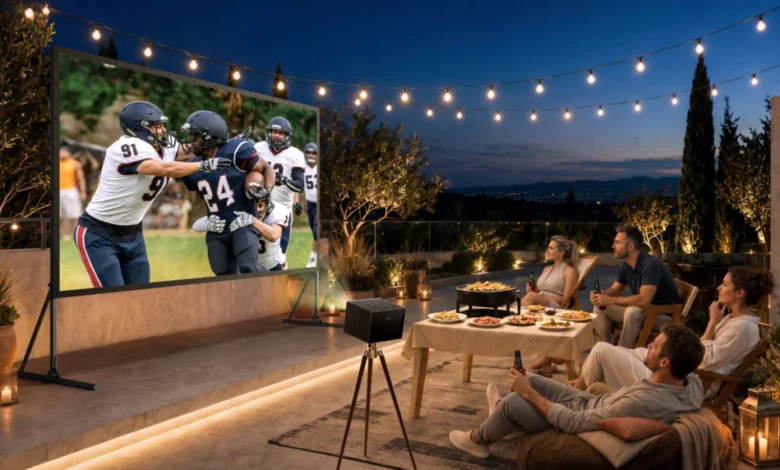
You don’t need a festival budget, a professional production crew, or a neighborhood committee with twelve subcommittees to bring people together for a movie.
Sometimes, all it takes is a shared lawn, a projector, a few folding chairs, and someone willing to organize the details.
A neighborhood movie night is one of those rare activities that works across generations. Kids can spread blankets on the grass, parents can catch up with neighbors, and longtime residents get a chance to meet families who moved in last month.
For a gathering of 15 to 30 people, the planning can stay surprisingly simple. The secret is to make a handful of decisions early, share the responsibilities, and keep the event small enough to manage comfortably.
Here’s how to organize an outdoor screening that feels like a genuine community gathering rather than an elaborate production.
Start With a Space Everyone Can Reach
A neighborhood movie night doesn’t require a public park. A shared courtyard, HOA green space, apartment community lawn, or generously sized private property may work just as well.
The important questions are practical.
Can everyone find the location? Is there enough room for seating? Can people reach a restroom? Will the event interfere with traffic, parking, or neighboring homes?
Walk through the proposed location during the evening, preferably around the same time you plan to host the movie.
Look for:
- A relatively level viewing area where chairs and blankets can sit comfortably.
- A suitable screen location with minimal interference from streetlights or porch lights.
- Nearby electrical access that doesn’t require cords crossing busy walkways.
- Accessible paths and seating for neighbors who use mobility aids or cannot comfortably sit on the ground.
- A convenient restroom that guests have permission to use.
If you’re considering an HOA common area or an apartment courtyard, obtain approval from whoever manages the space before announcing the event.
Depending on your location, permits, insurance requirements, occupancy limits, or noise restrictions may apply. A modest gathering on private property can involve fewer logistical hurdles, but that doesn’t automatically exempt it from local rules.
Keep the first event manageable. It’s easier to build on a successful gathering of 20 people than recover from an ambitious event that overwhelms your volunteers.
Choose the Movie Before Sending Invitations
Movie selection may be the only part of the planning that inspires passionate debate.
Someone will suggest a superhero blockbuster. Another neighbor will insist on an animated classic. There’s always one person hoping for a three-hour epic.
For a mixed-age community audience, accessibility and running time matter more than personal favorites.
A family-friendly movie lasting around 90 to 110 minutes is often a practical choice, especially when younger children are attending and the screening can’t begin until after sunset.
Consider the audience’s age range, content rating, and whether the movie includes scenes that might be inappropriate for a community event.
You can invite neighbors to vote between two or three suitable options rather than opening the selection to unlimited suggestions.
Don’t Forget Public Screening Rights
This is one detail community organizers really shouldn’t overlook.
Showing a copyrighted movie at a neighborhood or HOA event generally requires public performance permission, even if you aren’t charging admission.
Buying a DVD or subscribing to a streaming service doesn’t automatically grant the right to screen that movie publicly.
In the United States, a screening open to the public—or attended by a substantial group outside the normal circle of family and friends—can qualify as a public performance under copyright law.
Before advertising the title, confirm the necessary permission through the rights holder or an authorized licensing provider. Make sure the license covers your chosen movie, location, and date.
If the budget is tight, investigate films with appropriate public screening permissions rather than assuming a free event requires no license.
Sorting this out early prevents an awkward last-minute change of plans.
Build a Simple Setup, Not a Miniature Movie Theater
A neighborhood event doesn’t need equipment that looks impressive in photographs. It needs equipment that works reliably for the audience and location.
For 15 to 30 guests, a screen in the 100- to 150-inch range may be appropriate, depending on seating distance and site layout.
The projector needs enough brightness for the planned screen size, but remember that outdoor projection generally works best after the sky has darkened.
You should also consider throw distance. Many conventional projectors require several feet between the lens and screen, so you’ll need a stable equipment position outside the main walking routes.
When comparing Valerion projectors, look at the supported screen sizes, optical zoom, throw ratios, and available connections rather than choosing solely by the highest advertised resolution.
These specifications help determine whether the projector can produce the intended picture from a practical location.
A 4K image can be excellent for outdoor movies, but a reliable playback source, clear audio, and well-positioned screen will often have a greater impact on the overall event than chasing every possible technical upgrade.
For a small community gathering, prioritize equipment that volunteers can set up, operate, and take down without specialized training.
Choose a Screen That Won’t Complicate Setup
A white wall might work for a private backyard screening, but shared outdoor spaces rarely offer a suitable permanent projection surface.
That makes portability especially valuable.
A portable outdoor projector screen can be transported to the gathering location, assembled for the screening, and packed away afterward.
Depending on the design, a portable screen may use a folding frame, detachable supports, or an inflatable structure.
Before choosing one, consider three things:
Assembly: Can two volunteers put it together without special tools? How long does the process take?
Stability: Does the manufacturer provide appropriate anchoring methods and wind limitations? Large screens can catch substantial wind.
Storage: Will the packed screen fit in an ordinary vehicle, and is there somewhere dry to store it between events?
Never improvise anchoring for a large screen. Follow the manufacturer’s setup and wind-safety instructions.
If the weather becomes too windy, postpone the screening or move to a suitable indoor venue. A screen blowing over isn’t a reasonable trade-off for keeping the event on schedule.
Let Neighbors Help Without Creating a Committee
One person can coordinate a small movie night, but that doesn’t mean they should handle everything.
The easiest approach is to assign a few specific responsibilities instead of asking people vaguely to volunteer.
| Responsibility | What the Volunteer Handles |
| Event coordinator | Confirms location, permissions, invitations, and schedule |
| Equipment lead | Tests the projector, screen, sound, and power |
| Welcome helper | Directs guests, answers questions, and manages seating |
| Refreshment helper | Organizes simple snacks, water, and cleanup supplies |
| Cleanup crew | Collects trash, folds chairs, and packs equipment |
One person can cover more than one role, and neighbors can share equipment if they agree in advance.
You might discover that someone already owns a projector, another neighbor has folding chairs, and a third has experience managing community activities.
A shared online sign-up sheet can handle most of the coordination.
There’s no need for weekly planning meetings. Just make sure each volunteer knows what they’re responsible for and when they need to arrive.
Make It Comfortable for Everyone
A community movie night should feel welcoming whether someone arrives with three children, comes alone, or uses a wheelchair.
Arrange seating with different needs in mind.
Leave clear routes from the entrance to the viewing area and restrooms. Provide a mixture of blankets and chairs, including chairs with back support.
Avoid placing all tall lawn chairs directly in front of families sitting on blankets.
For a casual gathering, consider dividing seating into two areas:
- Front section: Blankets, low chairs, and families who prefer sitting closer.
- Rear and side sections: Standard lawn chairs and accessible seating positions with clear sightlines.
This doesn’t need to become a rigid seating chart. A little guidance prevents guests from spending the movie staring at the back of someone else’s chair.
Keep pathways visible with low-glare lighting that doesn’t shine directly onto the screen.
If the movie and playback system support captions, consider enabling them. Outdoor dialogue can be difficult to hear, particularly when children are talking or nearby traffic creates background noise.
And make sure the sound is loud enough for the audience without overwhelming surrounding homes.
The aim is a welcoming neighborhood evening, not an outdoor concert.
Keep Refreshments Low-Maintenance
Food has a way of turning small gatherings into complicated events.
Someone offers to grill. Another person suggests a dessert contest. Suddenly, your casual movie night needs additional tables, refrigeration, and people handling food all evening.
Resist the temptation to overorganize.
For a gathering of 15 to 30 people, simple refreshments are usually enough.
Individual popcorn bags, bottled water, packaged snacks, and easy-to-serve treats keep preparation and cleanup manageable.
You can also invite families to bring their own picnic dinners.
If volunteers are providing food, collect allergy information where practical and follow appropriate food-safety requirements. Check any venue rules governing food distribution or sales.
A free, informal movie night doesn’t need a concession stand.
Often, giving everyone a chance to relax together is more valuable than offering an elaborate menu.
Plan for Sunset, Weather, and a Backup Date
Unlike an indoor gathering, an outdoor screening depends heavily on factors you can’t control.
Sunset time is one of them.
A movie scheduled for 7:30 p.m. might work perfectly in October but be nearly impossible to see at the same time in June.
Check the local sunset time and allow additional time for twilight before starting the screening.
Weather is the bigger uncertainty.
A forecast showing scattered showers doesn’t guarantee rain, but it should prompt a closer look at your backup plan.
Decide in advance whether you can move the event indoors, reschedule for another weekend, or cancel if conditions become unsafe.
If thunder is heard, move everyone into a substantial enclosed building or an enclosed hard-topped vehicle. A tent or open pavilion is not adequate lightning shelter. Follow National Weather Service guidance before resuming outdoor activities.
Also pay attention to wind. Even without rain, strong gusts can make a portable screen unsafe.
Make the weather decision before guests arrive whenever possible. A simple group message is better than leaving families standing outside wondering whether the event is happening.
Keep the Budget Visible and Reasonable
A neighborhood movie night can be affordable, especially when equipment and responsibilities are shared.
Rather than budgeting for every possible extra, focus on the essentials.
| Expense | Budget-Friendly Approach |
| Screening permission | Check licensing requirements and costs before selecting the movie |
| Venue | Use an approved community space or suitable private property |
| Projector and sound | Borrow suitable equipment or rent what is missing |
| Screen | Choose a portable setup appropriate for the audience |
| Seating | Ask guests to bring chairs and blankets |
| Snacks | Offer simple refreshments or encourage picnic-style meals |
| Decorations | Keep them minimal; the screen is the main attraction |
If several events are planned throughout the year, purchasing shared equipment might eventually make sense.
For a first-time gathering, borrowing or renting allows the community to test the idea without committing to a major expense.
Keep a record of costs so future organizers know what to expect.
A Two-Week Plan That Keeps Things Simple
You don’t need months of preparation for a small neighborhood screening, assuming the venue, permissions, and equipment are available.
A short timeline makes the work easier to share.
| When | Main Tasks |
| Two weeks before | Confirm the venue, required approvals, screening rights, and event date |
| One week before | Finalize equipment, volunteers, movie selection, and invitations |
| Two days before | Review weather, confirm supplies, and send neighbors a reminder |
| Event afternoon | Set up the screen, seating, power, and sound; test movie playback |
| Before sunset | Welcome guests, distribute refreshments, and check seating |
| After the screening | Pack equipment, collect trash, and return the venue to its original condition |
One last technical rehearsal is worth the effort.
Play several minutes of the actual movie using the intended source device. Confirm that the audio is synchronized, the picture is focused, and all cables are safely positioned.
For outdoor electrical equipment, use suitable outdoor-rated cords and GFCI protection. Keep connections dry, prevent trip hazards, and follow the equipment manufacturer’s operating requirements.
Most home projectors are not weatherproof, so don’t leave them exposed to rain or overnight moisture.
The Best Part Happens Before the Credits
A neighborhood movie night is about more than the film itself.
It’s the conversation between neighbors who usually only wave from their driveways. It’s the kids spreading blankets beside their friends. It’s someone bringing an extra chair for a person they just met.
Those moments don’t require an elaborate event plan.
A suitable space, proper permissions, reliable equipment, and a few helpful volunteers can be enough to create an evening people genuinely enjoy.
And if it goes well, you may have started something worth repeating—a monthly summer gathering, an annual fall movie night, or simply another reason for people on the same street to spend time together.
The movie gives everyone a reason to show up. The neighborhood is what makes the evening memorable.

